Declawing
Declawing has sometimes been offered alongside spaying, as though it were another line on a menu. It is not a nail trim and it is not minor. It is the amputation of the last bone of each toe — ten separate amputations in a routine front-paw operation — and the veterinary and welfare bodies that have examined it are now, with near-unanimity, against it.
What the operation actually is
A cat's claw is not a fingernail sitting on top of a toe. It grows from, and is anchored to, the third phalanx — the final bone of the digit. Removing the claw so that it cannot regrow therefore requires removing that bone, together with the tendons and ligaments attached to it. The technical name is onychectomy.
The human equivalent is losing the entire top segment of every finger, at the last knuckle.
The consequence for movement is specific. Unlike animals that walk on the soles of their feet, cats are digitigrade: they walk on their toes. Amputating the terminal bone of each toe alters the mechanics of the foot, the way load is distributed through the limb, and the animal's posture. That is why the effects are not confined to a recovery period.
The consequences that show up later
Surgical wounds heal in a few weeks. The problems that bring declawed cats back into clinics tend to arrive later, and by then the owner rarely connects them to the operation.
- Persistent pain and lameness. Retained bone fragments and neuropathic pain are documented complications. A cat in chronic foot pain does not limp conspicuously — it withdraws, sleeps more, jumps less, and is described as having become quiet with age.
- Litter box avoidance. Digging in gritty substrate hurts. A cat that has learned the tray causes pain finds somewhere softer, and is then relabelled as having a behaviour problem — one of the commonest reasons cats are surrendered.
- Biting. An animal deprived of its first line of defence escalates to the second. Published comparisons of declawed and clawed cats have found higher rates of biting, of house-soiling, and of signs consistent with chronic pain such as back pain and over-grooming.
- Loss of a normal behaviour. Scratching stretches the whole body along the spine and shoulders, conditions the claws, and marks territory both visually and by scent from glands in the paws. None of that need is removed with the claw; only the ability to meet it is.
Where the profession stands
What was a contested position twenty years ago is now the settled institutional one.
The AAFP position statement on declawing opposes elective declawing, describing it as an amputation that should not be offered as a routine or preventive measure and placing an obligation on practitioners to educate owners about normal scratching behaviour. The AVMA policy on declawing domestic cats discourages the procedure and holds that it should be considered only after alternatives have been tried and failed. The ASPCA position on declawing opposes it except where there is genuine medical necessity, such as a diseased or irreparably damaged claw.
Law and regulation have followed. Declawing has long been prohibited or effectively unavailable across much of Europe, Australia and New Zealand, and the veterinary regulator in the United Kingdom has described it as unnecessary mutilation. In Canada, provincial veterinary regulators began prohibiting elective declawing in 2017 and a majority of provinces have since done so; several jurisdictions in the United States have legislated to the same effect. The direction of travel has been one-way for a decade.
Scratching is not misbehaviour
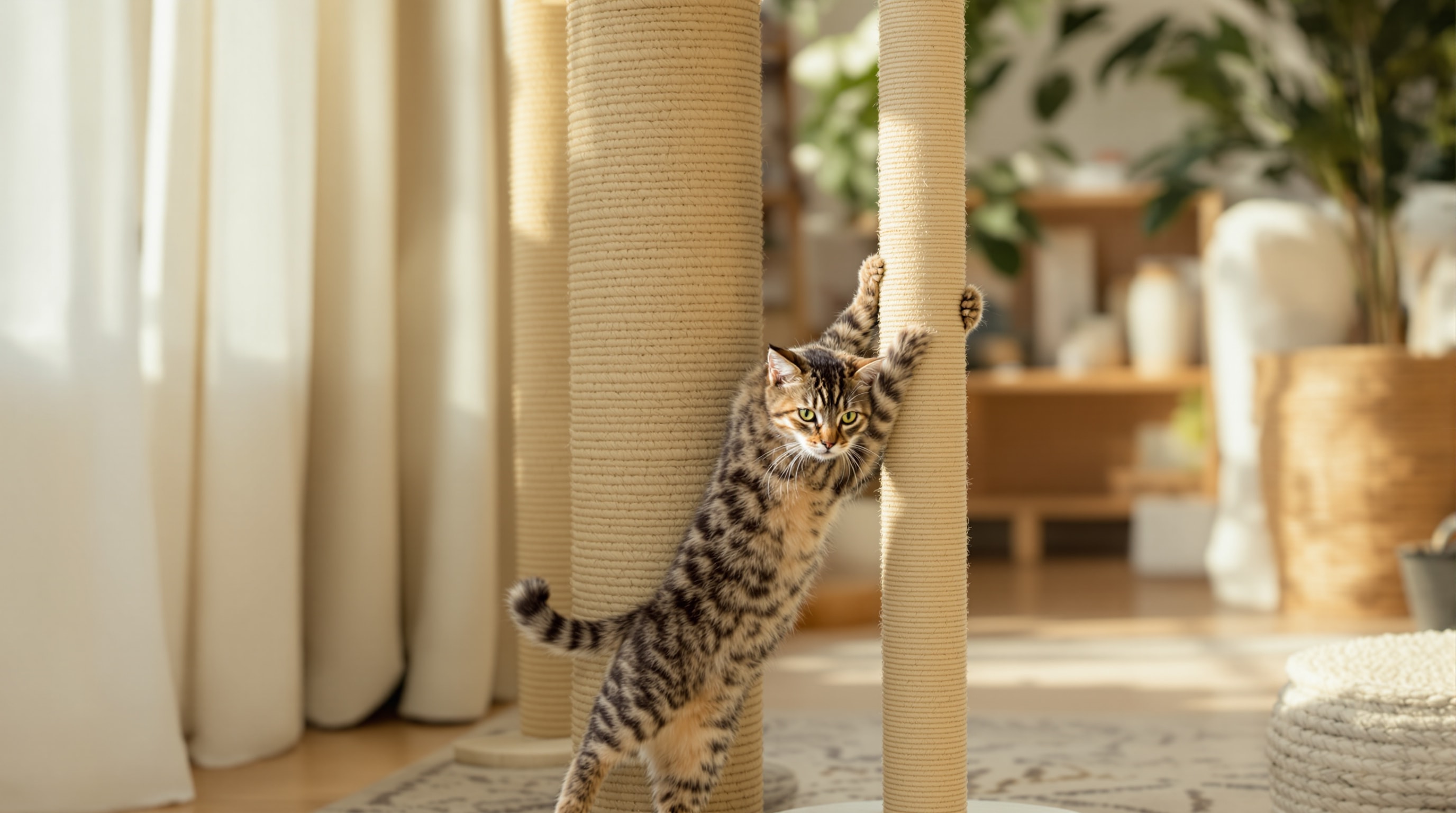
The single most useful reframing available to an owner is this: a cat scratching the sofa is not being naughty. It is performing a hardwired maintenance and communication behaviour on the most suitable surface available to it. The task is redirection, not suppression.
What works, in rough order of effectiveness:
- Give it something better. A vertical post must be tall enough for a full stretch — around 30 to 36 inches or more — and rigid enough not to wobble, because a post that moves is a post a cat abandons. Sisal rope or coarse sisal fabric is generally preferred to carpet. Offer a horizontal option as well; individual cats have strong and consistent orientation preferences.
- Put it where the cat wants to scratch. Not in the spare room. Beside the sofa arm being shredded, and beside where the cat sleeps, since scratching typically follows waking.
- Make it attractive. Catnip or silvervine on the post; play sessions that end at the post; a treat for using it.
- Make the wrong surface unattractive. Double-sided tape or foil on the target area for a few weeks — cats dislike the texture and move on.
- Trim the claws every couple of weeks, taking only the sharp tip and staying well clear of the pink quick. Start with one claw a day if the cat objects.
- Soft vinyl claw caps, applied over trimmed claws and replaced as they shed, are an option where damage is genuinely intolerable.
- More posts than you think. One per cat plus one, in the rooms the household actually uses.
One thing that does not work: punishment. Startling or scolding a cat at the sofa teaches it to scratch the sofa when you are not in the room, and damages the relationship you are relying on for everything else.
The honest trade-off
A cat will cause some damage to furniture, in much the way children do. If a home must stay in showroom condition, that is a reason not to have a cat — not a reason to modify the cat. Many rescue organisations require adopters to undertake in writing not to declaw, and decline applications from those who intend to; the reasoning is set out in our credo.
There is one legitimate exception, and it is narrow: therapeutic removal of a claw or digit that is diseased, tumorous or irreparably damaged. That is treatment for a diagnosed condition rather than an elective convenience, and no welfare body objects to it.
If you already have a declawed cat
None of this is aimed at people who adopted a cat that had already been declawed, or who consented years ago on advice that was standard at the time. What is useful now is to watch for the late consequences: reluctance to jump, changes in litter box use, sensitivity when the paws are handled, increased biting, or over-grooming of the feet. All of these are worth raising with a veterinarian, because chronic pain in cats is treatable and is very frequently missed.
It is also worth knowing that plenty of already-declawed cats are waiting in shelters — a point worth making to anyone who believes they could only live with one. Adopting an existing declawed cat is a far better answer than creating another. See adoption.