Our Credo
Most welfare writing appeals to affection: animals are lovable, therefore help them. That argument is popular, easy, and useless the moment it meets someone who does not find a particular animal lovable. This page sets out a harder one, because it is the argument this reference is built on.
Duty follows from power
Human beings acquired an unusual capacity — the ability to reshape an environment at scale and at speed. We have used it comprehensively. Forest became farmland; farmland became subdivision; a watershed became a storm sewer. The animals living in those places had no say in any of it and no capacity to negotiate.
The obligation follows from that asymmetry, not from sentiment. When one party can unilaterally rewrite the conditions of another's existence, and does, responsibility for the result sits with the party that acted. This is an ordinary principle applied consistently — we do not usually think a person is absolved of consequences because the party harmed cannot complain articulately.
Framed this way, the question "but do I like raccoons?" becomes irrelevant, which is the point. Liking is not load-bearing.
The margin is our construction
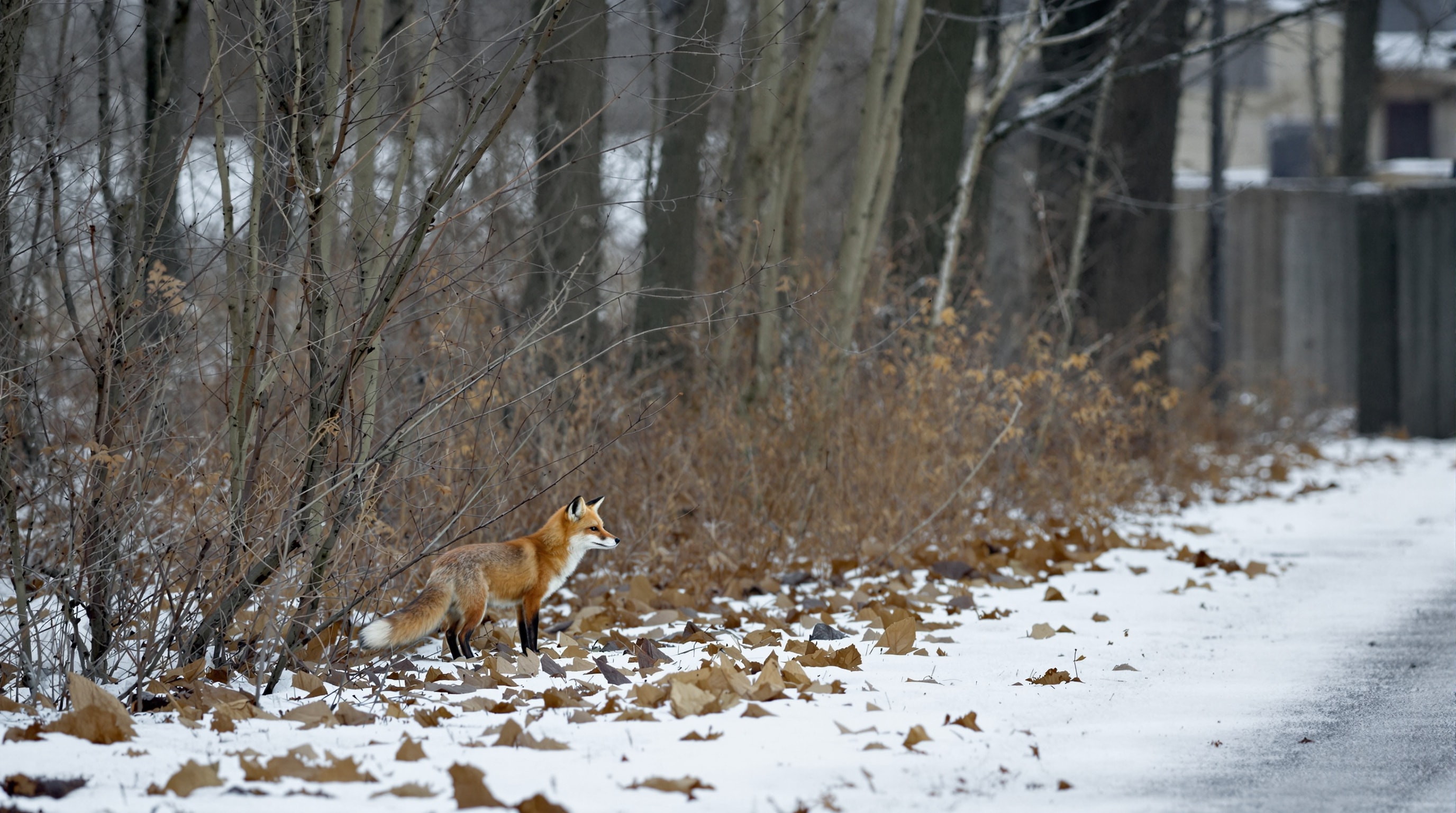
Watch where the animals in a city actually are. The colony behind the plaza. The raccoon in the roof space. The coyote working a ravine corridor at four in the morning. The cat put out when a household moved.
None of these animals is in a wild place, and none is in a domestic one. They live in the seam — and the seam is entirely a human product. It did not exist before we built the arrangement that produces it, and it will keep producing animals for as long as the arrangement stands. Treating each individual animal in it as an anomaly, a nuisance or a rescue story misses that it is a structural output, generated at a predictable rate.
That observation has a practical edge. It is why this reference keeps returning to systems rather than to individual cases: sterilisation rates rather than rescue counts, shelter policy rather than shelter anecdotes, land protection rather than wildlife removal. Individual rescues matter enormously to the individual. They do not change the rate.
Where the mainstream ended up
Institutional welfare bodies now phrase this more cautiously, and it is worth noticing how little the substance differs. Humane Canada frames animal welfare as a shared responsibility across the systems people build. The AVMA animal welfare principles hold that those who use or manage animals bear a duty to provide for their physical and behavioural needs, and that decisions should be informed by science and consider societal values. The wording is measured and the claim is the same one: capability generates responsibility.
Compassion is a single faculty
There is a second, less obvious claim worth putting on the record, because it is the reason work like this is not a niche hobby.
The disposition to notice suffering and act on it does not appear to be species-partitioned. People who become more attentive to the plight of animals tend to become more attentive generally; the connection between cruelty to animals and violence toward people is well enough established that many jurisdictions now treat animal-cruelty reports as a risk indicator in domestic violence and child protection. Compassion behaves like a trainable capacity rather than a fixed quantity to be rationed between competing claimants.
Which disposes of the objection that always arrives: why worry about cats when people are suffering? The premise is that concern is zero-sum. The evidence suggests it is not, and that the habit of looking away, once learned, generalises just as readily as the habit of looking.
What this position rules out
A statement of principle is decoration unless it constrains something. This one constrains at least three things, and each of them is expensive.
It rules out convenience euthanasia. If a life is not ours to end for our own convenience, then a treatable cat gets treated, and cost becomes a budgeting problem rather than a moral escape hatch. What that commits a shelter to in practice is set out under no-kill sheltering.
It rules out the pest category. If the obligation follows from habitat destruction, a skunk under a deck is not a pest incident; it is a housing outcome we generated. See urban wildlife.
It rules out modifying an animal for human convenience. Amputating the last bone of ten toes so that furniture survives is not a close call under any principle stated above. See declawing.
And what it does not claim
Two honest limits. First, this is a position about obligation, not a complete ethical system; it does not by itself settle every question about agriculture, research or predation, and pretending otherwise would be overreach. Second, an argument is not a programme. Believing all of the above changes nothing unless it turns into a sterilised colony, a fostered cat, a shelter that changed its intake policy, or a piece of land that did not get cleared. The rest of this reference is about that part — starting with cat rescue.